【论文信息】
Tang F, Dai Y, Ma Z J. Retail channel, direct channel, or dual channels:which works better for manufacturers’ trade-ins?[J]. Asia Pacific Journal of Marketing and Logistics, 2026, DOI:10.1108/APJML-10-2025-2270. (SSCI, JCR Q1, 2025中科院3区,2026新锐2区TOP期刊).
【作者信息】
第一作者:唐飞,博士、副教授、硕士生导师,研究方向:物流与供应链管理。
【基金支持】
The National Natural Science Foundation of China (72471040); the Major Program for Leading Talent Cultivation in Philosophy and Social Sciences of Zhejiang Province (25YJRC009ZD); the Social Science Planning Project of Chongqing (2024NDYB075); and the Natural Science Foundation of Chongqing (CSTB2024NSCQ-MSX1137).
【论文摘要】
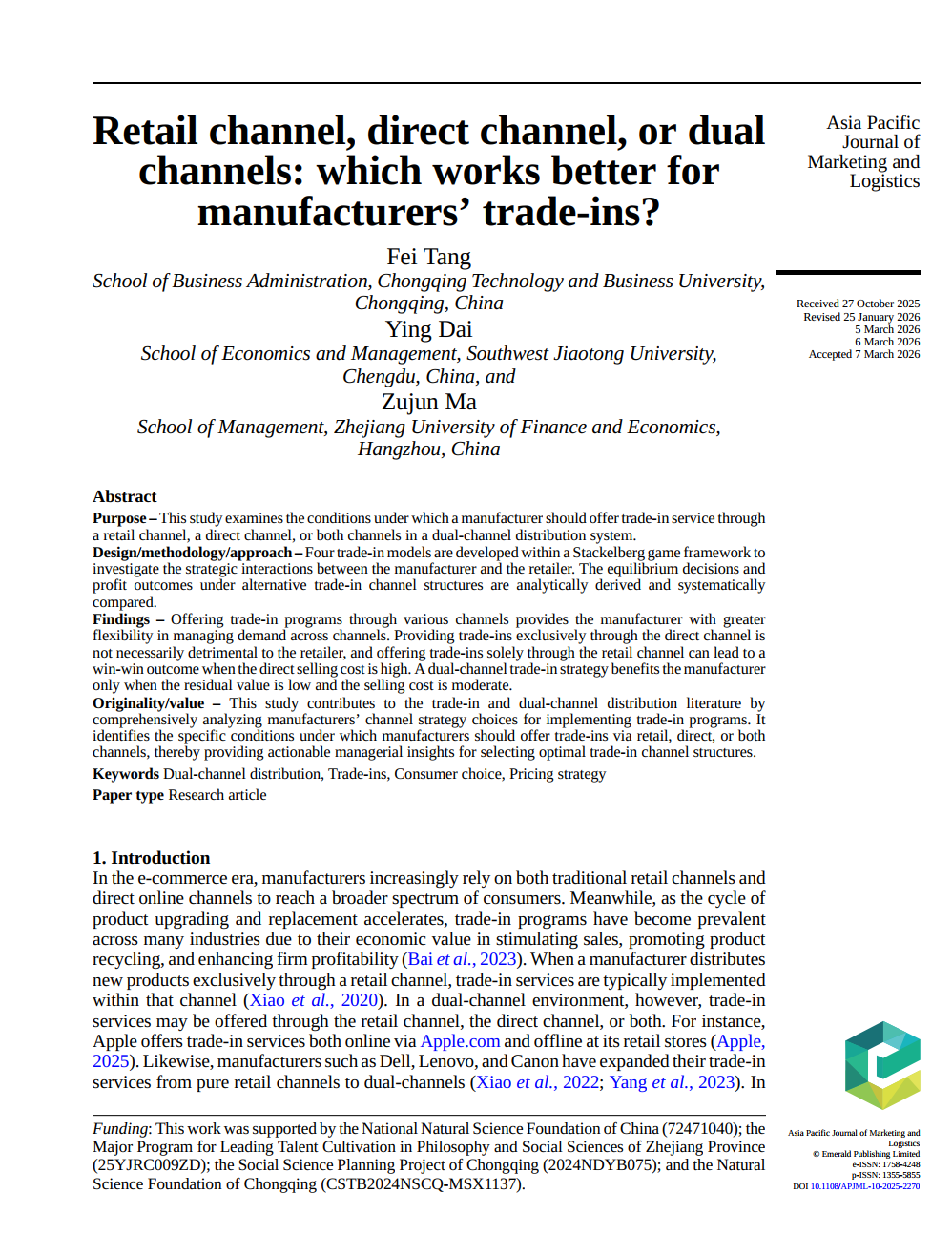
Purpose– This study examines the conditions under which a manufacturer should offer trade-in service through a retail channel, a direct channel, or both channels in a dual-channel distribution system.
Design/methodology/approach– Four trade-in models are developed within a Stackelberg game framework to investigate the strategic interactions between the manufacturer and the retailer. The equilibrium decisions and profit outcomes under alternative trade-in channel structures are analytically derived and systematicallycompared.
Findings– Offering trade-in programs through various channels provides the manufacturer with greater flexibility in managing demand across channels. Providing trade-ins exclusively through the direct channel is not necessarily detrimental to the retailer, and offering trade-ins solely through the retail channel can lead to awin-win outcome when the direct selling cost is high. A dual-channel trade-in strategy benefits the manufactureronly when the residual value is low and the selling cost is moderate.
Originality/value– This study contributes to the trade-in and dual-channel distribution literature by comprehensively analyzing manufacturers’ channel strategy choices for implementing trade-in programs. It identifies the specific conditions under which manufacturers should offer trade-ins via retail, direct, or both channels, thereby providing actionable managerial insights for selecting optimal trade-in channel structures.